

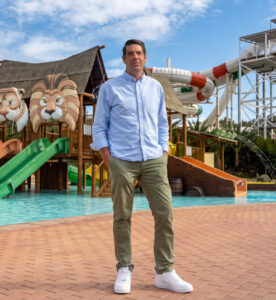
Interview with LUIS PEREA ESTEVE · Managing Director of Aqua Natura Benidorm.
VOICES OF THE REGION
Management, administration and strategic planning of the complex; supervision of expansion plans and new attractions; budget management; and leadership of the company’s sustainability commitment.
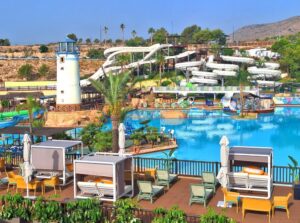
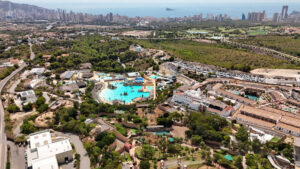
Aqua Natura Benidorm applies a family experience logic to aquatic leisure, with an open-plan venue measuring around 40,000 m² and a large central pool designed to cater for very different profiles, ages and degrees of intensity of use. Since it opened in 2009, the complex has expanded its offer with new attractions and children’s areas while refining its management of visitor flows, safety and comfort.
In this conversation, Luis Perea Esteve reviews the evolution of the park, its contribution to the tourist ecosystem of Benidorm and the Valencian Community and the criteria that guide the design and running of an infrastructure featuring water as a simultaneous experience, resource and critical management element. Digitisation, water and energy efficiency and greater hybridisation of technology and physical spaces are listed as some of the keys to the future.
| Facility | Aqua Natura Benidorm (operated by Terra Natura, S.A.) |
| Location | Foia del Verdader, 1 · Benidorm, Alicante, Valencian Community |
| Opening | 2009 |
| Approximate surface area | 40,000 m² |
| Central pool | Almost 6,000 m³ |
| Water slides | More than 1,000 metres, with different usage and intensity profiles |
| Evolutionary milestones | 2015 – Incorporation of Aqua Snake | Incorporation of the Aqua Snake slide, with an extended 150-metre zigzag route)
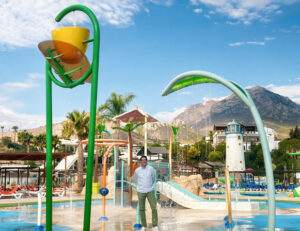
2018 – Opening of Adventure Island | A 1,400 m² children’s and family themed area with water castles, hydrotubes and controlled depth zones. 2023 – Remodelling of Ohana Splash | A 300 m2 splash-pad area without any height restrictions and continuous flexible non-slip paving. 2026 – Opening of Jungle Race | A multi-track racer attraction with immersive interior lighting systems for simultaneous use by four people on two different floats. |
| Ecosystem | It operates in partnership with Terra Natura Benidorm and the Pirates Island and Magic Natura themed resorts |
1. How would you describe Aqua Natura Benidorm and how has the project evolved from its inception to the present day?
I’d define Aqua Natura Benidorm as an innovative case within the engineering of aquatic leisure geared towards the family experience. Since it opened in 2009, or even the design phase, the project has focused on an open and comfortable area that’s capable of coping with intensive use.
Our evolution is visible in the different milestones. We began with a balanced range of slides, and we’ve gradually refined the proposal based on the inputs of our stakeholders, expanding the variety of the experiences. We’ve moved on from adrenaline-focused facilities like La Cresta to infrastructures specialising in interaction and barrier-free spaces such as the splash pad in Ohana Splash. With Jungle Race, our major new feature, we’ve revised the visitor flows to increase the usage capacity without lengthening the waiting times.
2. What role does a facility like Aqua Natura play in the tourism and leisure infrastructure of Benidorm and, more broadly, the Valencian Community?
Benidorm is the epicentre of holiday tourism on the Mediterranean coastline, and our parks serve as an engine of diversification and a unique complementary family product.
Our goal isn’t to have the highest slide, it’s to provide a safe environment in which different age groups and abilities can co-exist at a single venue. The integration with Pirates Island and Magic Natura adds value to the region by attracting a demanding international profile and contributing to longer stays, with the consequent impact on revenue and de-seasonalisation. We believe that this is a way of raising the standard of the Valencian Community towards a form of leisure based on comfort, safety and respect for the environment.
“Benidorm is the epicentre of holiday tourism on the Mediterranean coastline, and our parks serve as an engine of diversification and a unique complementary family product.”
3. What would you say is Aqua Natura’s current main value proposition, and what elements stand out in the experience that you offer visitors?
Our distinctive value proposition is the segmentation of the space to serve family peace of mind, in a constant search for efficiency. Technically, we structure the park to ensure that it can be enjoyed by both young children and families, by those seeking thrills and those who prefer relaxation.
This enables us to distribute the visitor flows organically and prevent bottlenecks. Besides, the geometries of our pools, attractions and slides are carefully designed, from the initial contacts with the water in Ohana Splash, in environments with excellent visibility and supervision, to evolutionary experiences such as Adventure Island, combined with the visual spectacle of Río Aventura and Aqua Snake. These are all complemented by competition and repetition mechanics such as Multipista and Jungle Race. The proposal doesn’t simply involve offering “water”, but rather creating a comprehensive sequence of aquatic experiences for everyone.
“The proposal doesn’t simply involve offering “water”, but rather creating a comprehensive sequence of aquatic experiences for everyone.”
4. At a facility where water is the core element, what are the main design, operational and management challenges that need to be addressed to provide a good visitor experience?
Managing an aquatic infrastructure like Aqua Natura Benidorm entails resolving a complex equation in which water is, at the same time, the means of recreation, the main risk factor and a critical regulated resource.
We place particular emphasis on the total visibility of the site. Clear views enhance safety, and they’re an aspect that our customers really appreciate. The park’s ergonomics are also key; our use of specialised, state-of-the-art paving and the proper distribution of the shaded areas are two of our main challenges, because they minimise impacts, prevent people from slipping and mitigate the high summer temperatures.
In terms of the operations and maintenance, we constantly strive to maintain optimal water quality. The control must be continuous and stable, and we must ensure strict compliance with the highest water health standards.
5. Which innovations and improvements have you incorporated into the facilities and their management in recent years?
We’ve focused entirely on operational digitisation and adapting the product to demand. To do so, we’ve relied on tools that allow us to ascertain and control the capacity of the Aqua Natura complex in real time.
We still have a long way to go in this field. Through technology, we want to improve the monitoring of what happens in our pools, obtain more data for analysis, identify patterns, optimise processes and anticipate and predict potential problems.
6. Efficient resource management is becoming increasingly important at any aquatic facility. How does Aqua Natura approach responsible water and energy use, and which advances do you regard as particularly relevant in this area?
According to our philosophy, fun has to go hand in hand with safety and sustainability. As for the latter, we operate under a closed water circuit model, whereby the water is constantly recirculated, filtered and purified by means of advanced filter washing and recovery systems so as to minimise any flow losses.
To date, one of our most significant milestones in terms of energy efficiency has been the installation of a 1,000 kW photovoltaic solar plant at the site. This enables us to cover a substantial part of its high electricity demand and play an active part in the green transition of European leisure infrastructures.
7. Looking ahead towards the next few years, how do you think water parks and facilities will evolve, and what factors will you prioritise to remain attractive, efficient and competitive?
I don’t think the future of the aquatic leisure sector lies in having the slide with the highest free fall. Our track record shows that interaction density per square metre is more valuable than massive-scale intensive use. Several interesting things can and should happen at the same time in a compact area that isn’t overcrowded. It’s possible to ensure extremely high family retention and great comfort with optimised water and energy consumption. This will help us to become more sustainable, but also more competitive.
Based on our experience and what we’ve seen, we believe that the use of technology and its hybridisation with physical elements will play a major part in the evolution in the sector, directly associated with the customer experience and revenue.
“Interaction density per square metre is more valuable than massive-scale intensive use.”