

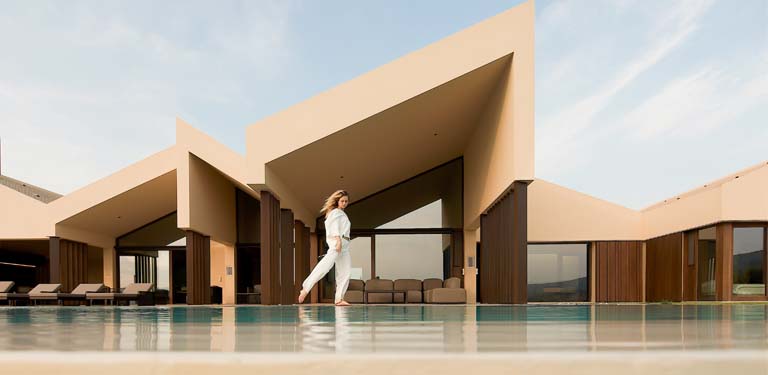
Source: Ramón Esteve Estudio, Clos de la Vila, Alfonso Calza
Interview with RAMÓN ESTEVE · Ramón Esteve Estudio.
VOICES FROM THE REGION
 Located in Valencia, Ramón Esteve Estudio approaches architecture and design from a comprehensive perspective in which material, landscape, and experience are all part of the same system. In this conversation, Ramón Esteve reflects on water as an architectural material, the integration of the swimming pool into the project, its connection to well-being and the Mediterranean territory, as well as the need to design with greater efficiency, moderation, and responsibility.
“The swimming pool should never be a standalone or merely functional element”
What role does water play in your approach to architecture and what does it contribute to the experience of the spaces you design?
I feel that water is but another material in architecture. I do not see it as merely an added or decorative element, but as a material capable of building a space, atmosphere, and emotion. Just like we work with stone, wood, light, or shadow, we also work with water for its ability to transform the perception of a place.
In Mediterranean architecture, water has always had an essential presence. It has served to refresh, to reflect, to accompany, to introduce calmness. In our projects, it often appears in a subtle way, integrated into the very logic of the house or the landscape. Water expands the space, multiplies the light, introduces movement and sound, and creates a deeper relationship between the architecture and its inhabitant.
I am especially interested in its sensory condition. Water is not perceived by sight alone. It is heard, felt in the temperature, in the humidity, in the reflection of the light on the roofs or walls. It has a highly emotional dimension. It can transform a space into a place of contemplation, pause, and intimacy. In that sense, it is part of a way of understanding architecture as a complete experience, not just as a formal composition.
In your projects, how is the pool or aquatic space integrated within the overall architectural concept?
The swimming pool should never be a standalone or merely functional element. The way we work, the aquatic space is part of the overall concept of the project. It can act as an extension of the home, as a transition between interior and exterior, as a vacuum that organises the whole, or as an element that links the architecture with the landscape.
The swimming pool is often considered another room of the house, even though it is outdoors. It is not just a place to bathe, but a space for socialising, resting, and contemplating. Its position, geometry, and materiality must respond to the same logic as the rest of the project. It must belong to the architecture.
I find it interesting when water helps to blur the boundaries. Between the house and the garden, between the pavement and the horizon, between the built matter and the landscape. A sheet of water can be a horizontal plane that provides continuity to the project, reflects the sky, introduces depth, and allows the architecture to interact with its surroundings in a more natural way.
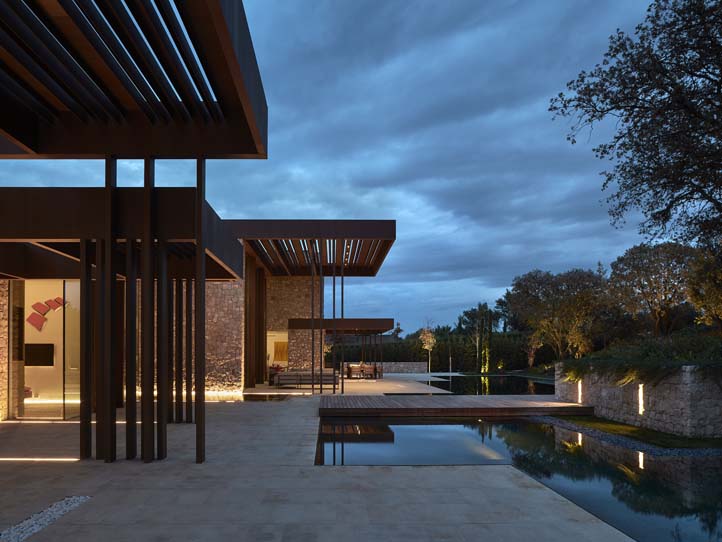
Source: Ramón Esteve Estudio, La Finca, Mariela Apollonio
Apart from its recreational function, what relationship do you establish between water, well-being, and the quality of life of those who use these spaces?
Well-being depends not only on physical comfort but also on the emotional quality of the spaces. Water has a great capacity to generate serenity. His presence introduces a more human, more measured scale. It invites you to stop, to look, to listen, to be.
In a home, especially in the Mediterranean context, outdoor spaces are a fundamental part of daily life. Water helps make them more livable. It refreshes the atmosphere, softens the light, provides privacy, and creates a sense of shelter. But above all, it creates a more intense relationship with time and with nature.
There is something very primitive and, at the same time, very contemporary in that relationship. Water is connected to an idea of essential well-being, far from the superfluous. It is not about luxury understood as excess, but as quality of life: being able to enjoy the light, the shade, the silence, the temperature, the landscape. Architecture must create the conditions for that experience to be possible.
Which design decisions are particularly important when planning a swimming pool or an aquatic environment?
The first important decision is the position. Water should be located so that it makes sense within the life of the project. It can open onto a view, protect a private space, organise pathways, or create a transition between the house and the garden. It’s not just about installing a swimming pool, but about understanding the role it should play in the composition and in the everyday experience.
Geometry is also essential. In our projects, it usually reflects a desire for clarity and proportion. Water, by its very nature, already introduces movement. That is why we often want to work with serene, precise, almost abstract forms. A well-proportioned sheet of water can have great architectural strength.
Materials, edges, the relationship with the pavement, lighting, and vegetation are also fundamental. The meeting between water and architecture must be carefully managed. An edge can make the pool appear as a separate object or, on the contrary, as a continuation of the built surface. Lighting can turn water into a very subtle nocturnal presence. Vegetation can provide shade, privacy, and a more direct connection with the landscape.
“A well-designed swimming pool is not necessarily the largest, but the one that best suits the location, the use, and the climate”
How are architectural intent and increasingly important issues such as efficiency, water and energy consumption, maintenance, and durability combined in these spaces?
Today, we cannot design aquatic spaces without considering efficiency, maintenance, and durability. Architecture must be responsible, especially in a territory where water is a valuable resource. This does not impoverish the project; on the contrary, it requires designing with greater precision.
Sustainability begins with initial decisions such as the appropriate size, orientation, protection against evaporation, the choice of efficient systems, construction quality, and the selection of durable and easy-to-maintain materials. A well-designed swimming pool is not necessarily the largest, but the one that best suits the location, the use, and the climate.
In recent years, these demands have changed the way of designing. We are more aware that every element must be justified. Water must add real value to the project, not just a look. We also seek solutions that reduce consumption, improve energy efficiency, and extend the lifespan of spaces.
“Water must add real value to the project, not just a look”
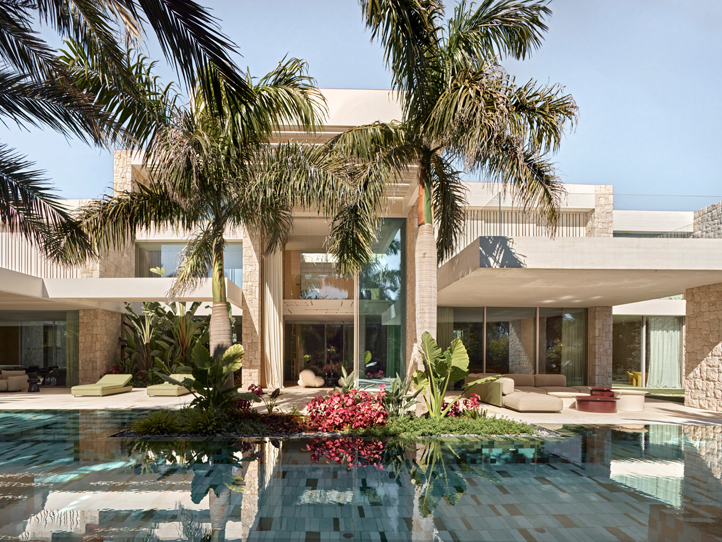
Source: Ramón Esteve Estudio, Casa Jacaranda, Mariela Apollonio
From your experience with projects developed in the Valencian Community, are there characteristics of the territory—climate, landscape, Mediterranean culture, or way of living—that particularly influence your approach to working with water? How do you think this relationship will evolve in the coming years?
The Valencian Community has a very close relationship with water, although it is also very aware of its scarcity. The sea, the irrigation channels, the courtyards, the pools, the gardens, the orchard, and the culture of shade are all part of a very present Mediterranean memory. All of that influences our way of designing.
The climate allows for living outdoors for much of the year. Therefore, architecture cannot be understood solely from the constructed area, but from the continuity between interior and exterior. Water participates in that continuity. It helps to create microclimates, to reflect light, to accompany shaded areas, and to build a way of inhabiting the space that is more connected to the environment.
I believe that in the coming years the relationship with water will be more essential and more precise. There will be less desire for display and more awareness of use, efficiency, and purpose. Water will continue to be important in Mediterranean architecture, but it must be used intelligently, sparingly, and responsibly.
At its core, it is about reclaiming a wisdom that was already present in traditional architecture, such as using resources naturally, taking advantage of the climate, providing protection from the sun, creating shade, ventilating, cooling, and creating spaces where life can happen simply.